1 July 2026·15 min read
23 June 2026•Sokudo Electic India
Published: June 23 2026 | Author: Sokudo Electric India Editorial Team
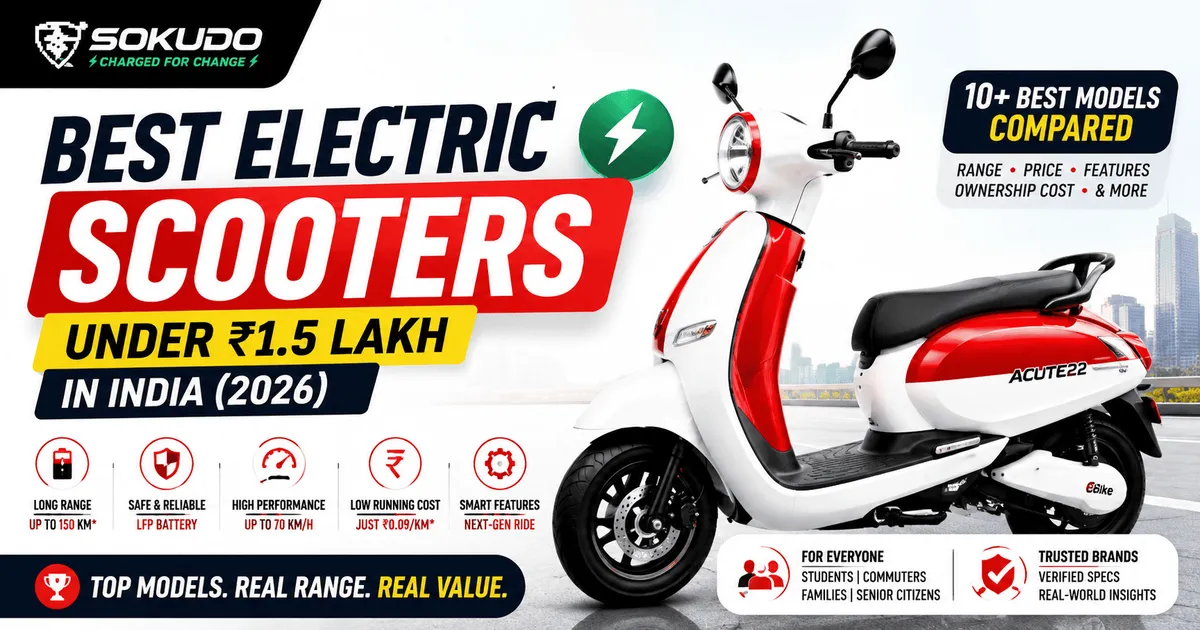
In 2026, Rs 1.5 lakh is the single most important price threshold in India's electric scooter market. It is not arbitrary. It is where the largest number of serious, capable electric scooters are concentrated, and it is where the PM E-DRIVE central government subsidy eligibility caps out for individual buyers.
Below Rs 1.5 lakh, Indian buyers in 2026 can access scooters with genuine 100 to 150 km claimed range, 70 to 80 km/h top speed, disc brakes, LFP battery chemistry, 34 to 56 litre storage, TFT dashboards, Google Maps navigation, hill-hold assist, and three to five year warranties.
That was not true three years ago. It is very true now.
The challenge is not finding an electric scooter under Rs 1.5 lakh. The challenge is choosing the right one among a crowded field of genuinely capable options, each with different strengths, different battery chemistry, and different ownership profiles.
This guide cuts through all of it. Every model is assessed on verified 2026 pricing, actual battery chemistry (not just "lithium-ion"), claimed versus realistic real-world range in Indian riding conditions, five-year running cost, persona fit, and long-term value. Where Sokudo models are the honest recommendation, they are named. Where a competitor is genuinely better for a specific use case, that is stated clearly too.
| Category | Best Pick | Price |
| Best overall value | Sokudo Acute | Rs 1,25,951 |
| Best for students and no-licence buyers | Sokudo Plus | Rs 67,951 |
| Best for families | Ather Rizta Z 2.9 | Rs 1,21,000 (approx) |
| Best for office commuters (25 to 40 km) | Sokudo Rapid 2.2 or Select 2.2 | Rs 99,951 to Rs 1,03,951 |
| Best premium under Rs 1.5 lakh | Bajaj Chetak 3503 | Rs 1,10,000 (approx) |
| Best for senior citizens | Sokudo Plus or Bajaj Chetak C2501 | Rs 67,951 to Rs 91,399 |
| Best service network | TVS iQube or Bajaj Chetak | Rs 1,10,000 to Rs 1,14,000 |
| Best low running cost (confirmed) | Sokudo (any model) | Rs 0.09/km |
Under Rs 80,000: This band now includes the Sokudo Plus (Rs 67,951) and a handful of non-RTO and entry-level models. At this price, buyers get LFP battery technology, up to 100 km claimed range, and in the Plus's case, a certified non-RTO, no-licence classification. For students, senior citizens, and homemakers with short daily distances, this band often delivers everything they actually need without the ownership complexity of a registered vehicle.
Rs 80,000 to Rs 1.2 lakh: The largest volume band. This is where the Sokudo Pace (Rs 83,951), Sokudo Rapid 2.2 (Rs 99,951), Sokudo Select 2.2 (Rs 1,03,951), Hero Vida VX2 (Rs 99,490), Bajaj Chetak 3001 (Rs 99,990), and Sokudo Acute 2.2 (Rs 1,04,951) compete. At this price, buyers get 70 km/h top speed, 100 to 142 km claimed range, disc brakes, connected features, and increasing warranty coverage. Battery chemistry varies: some models use LFP, some use lithium-ion NMC.
Rs 1.2 lakh to Rs 1.5 lakh: The premium end of the under-1.5L band. This includes the Ather Rizta Z 2.9 (around Rs 1,21,000), Honda Activa e (Rs 1,18,147), TVS iQube (Rs 1,13,742 to Rs 1,15,000), Bajaj Chetak 3503 (around Rs 1,10,000), and the Sokudo Acute (Rs 1,25,951). At this price, buyers gain TFT dashboards, better storage, stronger suspension, navigation integration, hill-hold, and in some cases touchscreen interfaces. The Sokudo Acute brings 150 km claimed range and LFP chemistry. The Ather Rizta and TVS iQube bring wider service networks and family-focused features.
| Sub-band | What you realistically get |
| Under Rs 80,000 | Non-RTO options, LFP chemistry at entry, 100 km claimed range, basic features |
| Rs 80,000 to Rs 1.2 lakh | 70 km/h top speed, 100 to 142 km range, disc brakes, connected features, mixed battery chemistry |
| Rs 1.2 lakh to Rs 1.5 lakh | TFT dashboards, 34 to 56L storage, hill-hold, navigation, LFP or large-capacity lithium-ion |
The current PM E-DRIVE central government scheme, running until July 31, 2026, provides Rs 2,500 per kWh of battery capacity capped at Rs 5,000 per vehicle for qualifying electric two-wheelers priced at or below Rs 1.5 lakh. This subsidy is applied automatically at the dealership. Several states add further savings: Maharashtra offers Rs 10,000 per electric two-wheeler plus 100 percent road tax and registration fee waivers; Delhi offers Rs 5,000 to Rs 25,000 depending on the scheme variant active at purchase.
For a complete breakdown of how subsidies affect the real on-road cost of electric scooters in this band, see our guide on how government subsidies made electric scooters affordable in India.
Hero Master Comparison Table: Best Electric Scooters Under Rs 1.5 Lakh (2026)
| Model | Battery | Capacity | Claimed Range | Real-World Range (est.) | Top Speed | Ex-Showroom | Best For |
| Sokudo Plus | LFP | Undisclosed | 100 km | 80 to 95 km | 25 km/h | Rs 67,951 | Non-RTO, students, seniors |
| Sokudo Pace | LFP | Undisclosed | 125 km | 115 to 120 km | 55 km/h | Rs 83,951 | Budget city commuters |
| Hero Vida VX2 | Li-ion | 3.94 kWh | 142 km | 95 to 115 km | 80 km/h | Rs 99,490 | Long range on a budget |
| Sokudo Rapid 2.2 | LFP | 2.2 kWh | 100 km | 80 to 95 km | 70 km/h | Rs 99,951 | Office commuters, arterial roads |
| Bajaj Chetak 3001 | Li-ion | 3.0 kWh | 127 km | 90 to 105 km | 63 km/h | Rs 99,990 | Range + storage priority |
| Sokudo Select 2.2 | LFP | 2.2 kWh | 100 km | 80 to 95 km | 70 km/h | Rs 1,03,951 | Office commuters, LFP priority |
| Sokudo Acute 2.2 | LFP | 2.2 kWh | 100 km | 80 to 95 km | 70 km/h | Rs 1,04,951 | LFP performance commuters |
| Bajaj Chetak 3503 | Li-ion | 3.5 kWh | 151 km | 110 to 125 km | 70 km/h | ~Rs 1,10,000 | Longest range + metal body |
| TVS iQube ST | Li-ion | 3.5 kWh | 145 km | 100 to 120 km | 78 km/h | ~Rs 1,14,000 | Wide service network, performance |
| Honda Activa e | Li-ion | 1.5 kWh x2 | 102 km | 70 to 85 km | 80 km/h | Rs 1,18,147 | Honda brand trust, dual battery |
| Ather Rizta Z 2.9 | Li-ion | 2.9 kWh | 123 km | 90 to 105 km | 80 km/h | ~Rs 1,21,000 | Families, tech features, storage |
| Sokudo Acute | LFP | 3.1 kWh | 150 km | 130 to 145 km | 70 km/h | Rs 1,25,951 | Best value long-range LFP |
All prices are ex-showroom and may vary by city and dealer. Confirmed 2026 prices used where available. Real-world range estimates are based on mixed Indian urban riding conditions including stop-and-go traffic, standard rider weight, and ambient temperatures. Actual range varies with riding style, gradient, load, and weather.
Price: Rs 67,951 ex-showroom
Battery: LFP
Claimed range: Up to 100 km
Real-world range: 80 to 95 km
Top speed: 25 km/h (certified)
Running cost: Rs 0.09 per km
Licence required: No
Registration required: No
Battery and motor warranty: 3 years
Vehicle warranty: 1 year
The Sokudo Plus occupies a position no other scooter in this comparison can match: it is a certified non-RTO scooter with genuine 100 km claimed range and LFP battery technology at Rs 67,951. No driving licence is required. No RTO registration, number plate, or road tax is needed.
The LFP battery is specifically important at this price point. Most scooters under Rs 80,000 use standard lithium-ion chemistry. The Plus uses LFP, offering better thermal stability and longer cycle life (2,000 to 4,000 cycles) than NMC alternatives. The 3-year battery and motor warranty covers this asset well within typical daily commuting patterns.
Best for: Students without a driving licence, senior citizens wanting simple low-stress ownership, homemakers running errands within 15 to 20 km daily, and first-time EV buyers who want to start electric mobility without paperwork complexity.
Where it is not the right choice: If your commute involves arterial roads, flyovers, or distances above 25 km daily where 25 km/h becomes too slow.
For a full legal breakdown of the non-RTO classification and how to verify compliance, see our guide on can you ride an electric scooter without a licence in India.
Price: Rs 83,951 ex-showroom
Battery: LFP
Claimed range: Up to 125 km
Real-world range: 115 to 120 km
Top speed: 55 km/h
Running cost: Rs 0.09 per km
Battery and motor warranty: 3 years
Vehicle warranty: 1 year
The Pace brings 55 km/h high-speed registration and full riding capability at Rs 83,951, making it the most affordable high-speed LFP scooter in this comparison. The 125 km claimed range is competitive at this price point and LFP chemistry protects that range across Indian summer conditions better than lithium-ion alternatives.
At 55 km/h, the Pace suits city roads and moderate arterial routes well but may feel limited on faster ring roads and flyovers where traffic flows above 55 km/h.
Best for: Budget-conscious commuters covering 20 to 35 km daily on city roads and local arterial routes who want LFP battery chemistry and confirmed Rs 0.09 per km running cost.
Price: Rs 99,490 ex-showroom
Battery: Lithium-ion, 3.94 kWh
Claimed range: Up to 142 km
Real-world range: 95 to 115 km
Top speed: 80 km/h
Charging time: Under 2 hours (fast charge)
The Hero Vida VX2 is a standout in this price band primarily because of its 3.94 kWh battery delivering 142 km claimed range and 80 km/h top speed at under Rs 1 lakh. The fast charging capability (under 2 hours) is the fastest in this comparison at this price point and genuinely changes daily ownership convenience for commuters who cannot always rely on overnight charging.
Hero MotoCorp's national dealership and service network is one of the widest of any two-wheeler brand in India, spanning metros, Tier-2, and smaller cities, which reduces the service access risk that affects some newer EV brands.
The trade-off versus Sokudo models is battery chemistry: the Vida VX2 uses standard lithium-ion rather than LFP. In Indian summer conditions, this means higher heat degradation risk over time and a shorter theoretical cycle life.
Best for: Commuters who need the longest real-world range and fastest charging under Rs 1 lakh, and who value Hero's nationwide service network above LFP battery chemistry.
Price: Rs 99,951 ex-showroom
Battery: 2.2 kWh LFP
Claimed range: Up to 100 km
Real-world range: 80 to 95 km
Top speed: 70 km/h
Running cost: Rs 0.09 per km
Brakes: Disc front, Drum rear
Battery and motor warranty: 3 years
Vehicle warranty: 1 year
At essentially the same price as the Hero Vida VX2 and Bajaj Chetak 3001, the Sokudo Rapid 2.2 brings 70 km/h top speed, a disc front brake, LFP battery chemistry, and a confirmed Rs 0.09 per km running cost. The 100 km claimed range (realistically 70 to 80 km in Indian conditions) is lower than the Vida VX2 and Chetak 3001 at this price, but the LFP advantage in long-term heat durability and cycle life compensates for riders planning to keep the scooter for four to five years.
Best for: Urban commuters covering 25 to 40 km daily on arterial roads where 70 km/h is needed, who prioritise LFP battery durability and confirmed running cost over maximum claimed range.
Price: Rs 99,990 ex-showroom
Battery: 3.0 kWh lithium-ion
Claimed range: Up to 127 km
Real-world range: 90 to 105 km
Top speed: 63 km/h
Storage: 35 litres under-seat
Hill-hold: Yes
Bluetooth connectivity: Yes
Body: All-metal
At essentially the same price as the Sokudo Rapid 2.2, the Chetak 3001 presents a genuinely different ownership proposition. Its 127 km claimed range (realistically 90 to 105 km) outpaces the Rapid 2.2's 100 km claim significantly. The 35-litre under-seat storage, hill-hold assist, Bluetooth connectivity, all-metal body, and Bajaj's extensive nationwide service network are meaningful premium additions.
The Chetak 3001 uses standard lithium-ion chemistry without LFP's thermal stability benefits, and its 63 km/h top speed is below the Rapid 2.2's 70 km/h, which matters for arterial road riders. Drum brakes at both ends are less reassuring than the Rapid 2.2's disc front configuration.
Best for: Commuters who prioritise range, storage, hill-hold, and Bajaj's brand and service network over top speed and LFP battery chemistry. Ideal for riders covering 30 to 50 km daily who value total convenience features above outright performance.
Price: Approximately Rs 1,10,000 ex-showroom
Battery: 3.5 kWh lithium-ion
Claimed range: Up to 151 km
Real-world range: 110 to 125 km
Top speed: 70 km/h
Storage: 35 litres
Hill-hold: Yes
Body: All-metal
The Chetak 3503 delivers the longest real-world range of any scooter in this comparison below Rs 1.15 lakh, at approximately 110 to 125 km in Indian conditions. Combined with 70 km/h top speed, 35-litre storage, hill-hold, optional TecPac connectivity, and Bajaj's all-metal body, it is the most premium ownership package under Rs 1.15 lakh.
The trade-offs versus Sokudo Acute 2.2 (Rs 1,04,951) are battery chemistry (lithium-ion vs LFP), drum brakes at both ends versus Sokudo's disc front, and a Rs 5,000 higher price. The trade-off versus the Sokudo Acute (Rs 1,25,951) is a Rs 15,000 price saving with comparable range but no LFP chemistry advantage and no disc brake.
Best for: Riders who need maximum range (110 to 125 km real-world) with a metal body, 35-litre storage, hill-hold, and Bajaj's service network, and for whom battery chemistry is less of a deciding factor than raw range.
Price: Approximately Rs 1,13,742 to Rs 1,15,000 ex-showroom
Battery: 3.5 kWh lithium-ion
Claimed range: Up to 145 km
Real-world range: 100 to 120 km
Top speed: 78 km/h
Brakes: Disc front, Drum rear
Connected features: SmartXonnect, navigation, ride analytics
The TVS iQube brings one of the strongest service networks in the Indian electric scooter market. TVS Motor Company's network reaches a significant proportion of the country's towns and smaller cities, which is a genuine ownership advantage for buyers who are not near a metro service centre.
The 3.5 kWh lithium-ion battery delivers 145 km claimed range (realistically 100 to 120 km), competitive with the Chetak 3503 in this band. The SmartXonnect platform offers navigation, ride analytics, remote diagnostics, and OTA software updates. Disc front brake and 78 km/h top speed keep it competitive for arterial road commuting.
Best for: Riders who value the widest possible authorised service network, strong connected features, and high-speed performance in the Rs 1.1 lakh to Rs 1.15 lakh band.
Price: Rs 1,18,147 ex-showroom
Battery: Dual 1.5 kWh lithium-ion (swappable)
Claimed range: Up to 102 km
Real-world range: 70 to 85 km
Top speed: 80 km/h
Charging: Portable dual-battery swap
The Honda Activa e brings the most trusted brand name in India's scooter history to the electric segment. For buyers who would not consider a scooter from a newer brand regardless of specifications, the Activa e settles that question.
The dual portable battery setup is the most distinctive feature: both batteries can be detached and charged indoors from any standard socket, which completely solves the apartment charging problem for riders without dedicated parking outlets. The 80 km/h top speed is among the highest in this comparison.
At Rs 1,18,147, the 102 km claimed range (realistically 70 to 85 km) is lower than comparable scooters from Ather and Bajaj at similar pricing, and the dual lithium-ion battery setup uses swappable packs rather than an integrated LFP cell. Honda's EV service network is still developing relative to the established networks of TVS and Bajaj.
Best for: Buyers who trust Honda above all other brands, apartment residents without fixed charging access who need portable battery charging, and riders who want 80 km/h capability with a recognisable nameplate.
Price: Approximately Rs 1,21,000 ex-showroom (Delhi)
Battery: 2.9 kWh lithium-ion
Claimed range: 123 km
Real-world range: 90 to 105 km
Top speed: 80 km/h
Motor: 4.3 kW PMSM
Storage: 34 litres under-seat plus 22-litre optional frunk (total 56 litres)
Dashboard: 7-inch TFT (touchscreen via OTA update)
Hill-hold: Yes
Charging network: 5,900+ Ather Grid fast-charge points in 370+ cities
The Ather Rizta Z 2.9 is the most comprehensively family-oriented electric scooter in this comparison. It crossed 2 lakh units sold within 18 months of launch, making it one of India's fastest-selling electric scooters, which provides strong market validation.
The 56-litre total storage including a 34-litre under-seat space is the highest of any scooter in this comparison. The 7-inch TFT dashboard with touchscreen via OTA update, Magic Twist regenerative braking, AtherStack AI features including pothole alerts and crash detection, hill-hold, and Ather's 5,900-point fast-charge network are collectively the strongest technology package in this price band.
The trade-off versus Sokudo Acute (Rs 1,25,951) is battery chemistry: the Rizta Z uses lithium-ion where the Sokudo Acute uses LFP. The trade-off versus TVS iQube is Ather's more limited service network, concentrated in larger cities.
Best for: Families who want maximum storage, the most comprehensive smart features, a large fast-charging network, and strong overall build quality in a scooter that genuinely accommodates two adults comfortably.
Price: Rs 1,25,951 ex-showroom
Battery: 3.1 kWh LFP
Claimed range: Up to 150 km
Real-world range: 130 to 145 km
Top speed: 70 km/h
Running cost: Rs 0.09 per km
Brakes: Disc front, Drum rear
Kerb weight: 109 kg
Battery and motor warranty: 3 years
Vehicle warranty: 1 year
The Sokudo Acute is the most distinctive option in the Rs 1.2 lakh to Rs 1.3 lakh band for one specific reason: it is the only scooter under Rs 1.3 lakh combining 150 km claimed range with LFP battery chemistry. Every other scooter in this comparison with 120 to 153 km claimed range uses standard lithium-ion NMC chemistry.
At Rs 0.09 per km, the Sokudo Acute also delivers the lowest confirmed running cost in this entire comparison. A rider covering 35 km daily spends approximately Rs 3.15 per day or Rs 95 per month on electricity. Over five years at 35 km daily, electricity costs total approximately Rs 5,700, compared to Rs 19,000 to Rs 25,000 for lithium-ion alternatives at typical Indian tariffs, and Rs 1.28 lakh to Rs 1.83 lakh for a petrol scooter at Rs 2.50 to Rs 4.00 per km.
The LFP battery's thermal advantage is meaningful for riders in high-temperature regions. While the Ather Rizta Z's 2.9 kWh lithium-ion pack delivers comparable real-world range today, LFP chemistry is more likely to retain a higher percentage of that range after three to four years of daily Indian summer commuting.
At 109 kg, the Acute is also meaningfully lighter than the Ather Rizta Z at 125 kg and the TVS iQube at 115 kg, which affects parking ease and daily handling.
Best for: Long-distance commuters covering 40 to 60 km daily who want maximum range, LFP battery durability, confirmed Rs 0.09 per km running cost, and the lowest price for a genuine 100+ km real-world range scooter using safe battery chemistry.
No current comparison guide for this keyword properly explains battery chemistry. This section fixes that.
Two chemistries dominate the under-Rs-1.5-lakh electric scooter market in India:
NMC (Nickel Manganese Cobalt) lithium-ion batteries are used by Ather, TVS, Bajaj, Honda, and Hero Vida. They offer higher energy density, meaning more range from a lighter, smaller pack. The Chetak 3503 achieves 151 km claimed range from 3.5 kWh. The Rizta Z achieves 123 km from 2.9 kWh. The trade-offs are lower thermal stability and a typical cycle life of 800 to 1,500 charge cycles before noticeable degradation.
LFP (Lithium Iron Phosphate) batteries are used across the entire Sokudo range, including the Plus, Pace, Rapid 2.2, Select 2.2, Acute 2.2, and Acute. LFP offers better thermal stability, longer cycle life of 2,500 to 4,000 cycles, and a stronger safety profile at the cost of slightly lower energy density requiring a larger pack for equivalent range.
Summer ambient temperatures in Delhi NCR, Jaipur, Ahmedabad, Nagpur, Hyderabad, and Chennai regularly exceed 42 degrees Celsius. Vehicle surface temperatures under direct sun run considerably higher. Stop-and-go urban traffic adds thermal stress through frequent acceleration cycles.
In these conditions, a 2.9 kWh NMC pack delivering 90 to 105 km of real-world range today may deliver noticeably less by year three or four of daily use, simply because lithium-ion chemistry degrades faster under sustained heat exposure than LFP chemistry does.
The International Energy Agency's analysis of global EV battery technology consistently highlights LFP's thermal stability advantage in high-temperature markets as a meaningful practical differentiator for long-term ownership.
In this comparison, LFP chemistry is exclusive to the Sokudo range: Plus, Pace, Rapid 2.2, Select 2.2, Acute 2.2, and Acute. All other models (Bajaj Chetak, Ather Rizta, TVS iQube, Honda Activa e, Hero Vida VX2) use lithium-ion NMC variants.
For buyers planning to keep their scooter for five or more years in Indian conditions, this is one of the most important differentiators in the comparison.
For a deeper breakdown of battery safety, thermal management, and AIS-156 certification, read our guide on are electric scooters safe in India.
Every scooter in this comparison is tested under IDC (Indian Driving Cycle) conditions, which represent ideal low-speed urban conditions rather than the varied, sometimes aggressive, high-temperature, traffic-congested conditions of actual Indian daily riding.
As a consistent rule, Indian riders can expect real-world range to run approximately 20 to 30 percent below the claimed IDC figure under mixed conditions including 30 to 50 km/h city speeds, typical Indian summer temperatures, standard 75 kg rider weight, and typical traffic stop-and-go patterns. In aggressive riding, extreme heat (above 42 degrees), or with a pillion and luggage, range can drop further.
| Model | IDC Claimed Range | Realistic Mixed City Range | Range in Peak Summer |
| Sokudo Plus | 100 km | 80 to 95 km | 55 to 70 km |
| Sokudo Pace | 125 km | 115 to 120 km | 75 to 90 km |
| Hero Vida VX2 | 142 km | 95 to 115 km | 80 to 100 km |
| Sokudo Rapid 2.2 | 100 km | 80 to 95 km | 60 to 72 km |
| Bajaj Chetak 3001 | 127 km | 90 to 105 km | 80 to 95 km |
| Bajaj Chetak 3503 | 151 km | 110 to 125 km | 95 to 112 km |
| TVS iQube ST | 145 km | 100 to 120 km | 88 to 106 km |
| Honda Activa e | 102 km | 70 to 85 km | 62 to 76 km |
| Ather Rizta Z 2.9 | 123 km | 90 to 105 km | 78 to 92 km |
| Sokudo Acute | 150 km | 130 to 145 km | 98 to 112 km |
Note: Summer range estimates for Sokudo LFP models are proportionally higher relative to competitor NMC models because LFP chemistry degrades less under heat. Over multiple years of daily use, LFP models are expected to retain a higher percentage of their original range than NMC alternatives under Indian conditions.
Five-Year Running Cost: Where the Real Money Is
Most buyers focus on purchase price. Five-year total cost tells a more complete story.
For a commuter covering 30 km daily (approximately 10,800 km per year, 54,000 km over five years) at a typical Delhi electricity tariff of Rs 8 per unit:
| Model | Purchase Price | 5-yr Electricity Cost | 5-yr Maintenance (est.) | 5-yr Insurance (est.) | 5-Year Total (est.) |
| Sokudo Rapid 2.2 | Rs 99,951 | Rs 4,860 | Rs 12,000 | Rs 16,000 | Rs 1,32,811 |
| Sokudo Acute | Rs 1,25,951 | Rs 4,860 | Rs 13,500 | Rs 18,000 | Rs 1,62,311 |
| Bajaj Chetak 3001 | Rs 99,990 | Rs 7,560 | Rs 13,000 | Rs 16,000 | Rs 1,36,550 |
| Bajaj Chetak 3503 | Rs 1,10,000 | Rs 8,100 | Rs 14,000 | Rs 17,000 | Rs 1,49,100 |
| Ather Rizta Z 2.9 | Rs 1,21,000 | Rs 7,020 | Rs 14,500 | Rs 18,000 | Rs 1,60,520 |
| TVS iQube ST | Rs 1,14,000 | Rs 7,560 | Rs 14,000 | Rs 17,000 | Rs 1,52,560 |
| Hero Vida VX2 | Rs 99,490 | Rs 5,940 | Rs 12,500 | Rs 16,000 | Rs 1,33,930 |
| Petrol scooter (125cc, Rs 85,000) | Rs 85,000 | Rs 1,35,000 (petrol) | Rs 35,000 | Rs 22,000 | Rs 2,77,000 |
Electricity costs for Sokudo calculated at confirmed Rs 0.09 per km. Electricity costs for other models estimated at Rs 0.14 to Rs 0.18 per km based on battery size, efficiency, and typical Rs 8 per unit tariff. Insurance estimates based on third-party plus comprehensive average for scooters in this price band. Figures are directional estimates and vary by state, model variant, riding style, and insurer. Petrol cost calculated at Rs 2.50 per km average.
Two conclusions are clear. First, every electric scooter in this comparison saves the rider Rs 1.1 lakh to Rs 1.5 lakh over five years compared to a petrol scooter at 30 km daily. Second, the Sokudo models consistently show the lowest five-year electricity cost due to the confirmed Rs 0.09 per km running cost, which translates to meaningful cumulative savings at higher mileage.
For the complete breakdown of how to evaluate five-year ownership cost including battery replacement risk and resale value, read our guide on how to choose the right electric scooter in India.
Resale value is almost entirely absent from competing comparison articles on this keyword. It matters.
Brand strength drives resale liquidity. Bajaj Chetak, TVS iQube, and Ather Rizta benefit from the largest second-hand buyer pools among electric scooters in India, simply because they have been in the market longer and sold in higher volumes. For Sokudo, the resale market is younger and less established.
Battery chemistry affects buyer confidence. A used scooter buyer's primary concern is remaining battery health. LFP batteries, with their 2,000 to 4,000 cycle life and documented thermal stability, give prospective second-hand buyers more confidence than lithium-ion NMC alternatives, especially if the original owner has ridden in high-temperature conditions. This can mitigate the brand familiarity gap for Sokudo models in the resale market.
Warranty coverage signals manufacturer confidence. A scooter sold with documented 3-year battery and motor warranty and 1-year vehicle warranty, with service history, presents lower risk to a second-hand buyer than one with ambiguous or shorter warranty terms.
Broad service network improves resale confidence. Bajaj, TVS, and Hero's nationwide reach means a second-hand buyer anywhere in India can access authorised servicing. Ather's strong presence in major cities but limited Tier-2 reach narrows its resale audience somewhat. Sokudo's developing network has similar constraints at this stage.
Rule of thumb for this segment in 2026:
Daily pattern: 10 to 20 km, mostly city roads, college, coaching, local errands. Many under 18 without a licence. Budget-sensitive.
No licence, no registration, no road tax. LFP battery. 100 km claimed range (80 to 95 km real-world). Rs 0.09 per km. For a student covering 15 km daily, monthly electricity cost is approximately Rs 40. The 25 km/h ceiling provides safety for newer riders and parental peace of mind. 3-year battery and motor warranty.
Alternative for students with a licence covering 20 to 35 km daily: Sokudo Rapid 2.2 at Rs 99,951
70 km/h, disc front brake, LFP battery, Rs 0.09 per km. Strong step-up for college students who need arterial road capability.
Running cost example: 15 km daily on Plus at Rs 0.09/km = Rs 1.35/day = Rs 41/month versus petrol at Rs 2.50/km = Rs 37.50/day = Rs 1,125/month. Monthly saving: Rs 1,084.
For a full breakdown of student-specific considerations including age rules and non-RTO verification, see our guide on the best non-RTO electric scooters in India.
Daily pattern: Mix of colony roads, main arterials, possibly one flyover. 5-day weekly commute. Home charging overnight.
Primary recommendation: Sokudo Rapid 2.2 at Rs 99,951 for 70 km/h, LFP battery, disc front brake, Rs 0.09/km.
Alternative for more range priority: Bajaj Chetak 3001 at Rs 99,990 for 127 km range, 35-litre storage, hill-hold, metal body, Bajaj's service network.
Alternative for premium tech: Ather Rizta Z 2.9 at approximately Rs 1,21,000 for TFT touchscreen, 56-litre storage, Magic Twist regen, Ather Grid fast-charge access, and 5-year/60,000 km warranty with Pro Pack.
Running cost example: 35 km daily on Sokudo Rapid 2.2 at Rs 0.09/km = Rs 3.15/day = Rs 95/month versus petrol at Rs 3/km = Rs 105/day = Rs 3,150/month. Monthly saving: Rs 3,055.
Daily pattern: Variable, often multi-stop: work, school drop, errands, market. Comfort and handling ease matter. Step-through frame important for clothing practicality.
Primary recommendation: Ather Rizta Z 2.9 for its combination of long seat comfortable for two, 56-litre storage, easy step-through access, 80 km/h performance, and soft riding characteristics. Weight at 125 kg is manageable.
Budget alternative: Sokudo Select 2.2 at Rs 1,03,951 for LFP battery, 70 km/h, Rs 0.09/km, and lighter weight at 100 kg, which makes daily parking and low-speed manoeuvring easier.
Both scooters offer step-through frames suited to traditional Indian clothing. The Sokudo Select 2.2's lower weight at 100 kg versus Rizta Z's 125 kg is a genuine practical advantage for shorter or lighter riders in tight parking situations.
Read more at: Best Electric Scooter For Women In India
Daily pattern: Under 15 km daily. Medical appointments, shopping, social visits. Low-speed confidence matters. Simple controls. No complex paperwork desired.
Primary recommendation: Sokudo Plus at Rs 67,951
Certified 25 km/h ceiling creates a calm, predictable riding experience. No licence, no registration. LFP battery. 100 kg weight is the lightest in this comparison. Reverse gear assists tight-space parking. 3-year battery and motor warranty.
Alternative for 55 km/h capability: Bajaj Chetak C2501 at Rs 91,399
107 kg, the lightest Chetak, with metal body, 113 km claimed range, and Bajaj's nationwide service network. Suitable for senior riders who have a licence and need moderate arterial road capability.
For the complete guide to electric scooters specifically suited to elderly riders including seat height comparisons and weight analysis, see our guide on the best electric scooters for elderly riders in India.
Daily pattern: Multiple daily uses: school drop, office commute, grocery, weekend use. Pillion comfort matters. Under-seat storage important. Reliability and service access are
top priorities.
Primary recommendation: Ather Rizta Z 2.9 at approximately Rs 1,21,000
56-litre total storage, the largest in this comparison. Long dual-adult seat. Pillion backrest. 80 km/h. Hill-hold. 5,900+ Ather Grid points for fast charging. TFT touchscreen.
India's fastest-selling electric scooter with over 2 lakh units sold, providing strong owner community and established service track record.
Budget family alternative: Bajaj Chetak 3001 at Rs 99,990
35-litre storage, hill-hold, 127 km range, metal body, Bajaj's nationwide service network at under Rs 1 lakh. Strong proposition for families who want reliability and range over tech features.
Daily pattern: Longer commute including arterial roads and possibly ring roads. Battery health over years matters. Single charge must comfortably cover the full day.
Primary recommendation: Sokudo Acute at Rs 1,25,951
150 km claimed range (135 to 140 km real-world). 3.1 kWh LFP battery. Rs 0.09/km. The LFP chemistry is specifically important for long-distance commuters because higher daily cycling accelerates battery degradation in NMC alternatives. At 109 kg with a disc front brake, the Acute is also lighter and better-braked than most longer-range competitors.
Alternative for maximum tech with comparable range: Ather Rizta Z 2.9 for TFT, Magic Twist regen, 56L storage, and Ather Grid fast-charge access at 5,900+ points.
Best Value Buyer (Prioritises lowest total cost of ownership, LFP battery, and running cost)
Pick from the Sokudo range. The Rapid 2.2 at Rs 99,951 for performance commuters, the Acute at Rs 1,25,951 for long-range commuters, and the Plus at Rs 67,951 for non-RTO buyers. All deliver Rs 0.09 per km, LFP battery chemistry, and 3-year battery and motor warranty.
Best Premium Feel Under Rs 1.5 Lakh (Prioritises features, storage, service network, and connected technology)
Ather Rizta Z 2.9 at approximately Rs 1,21,000 for families wanting maximum tech and storage, or Bajaj Chetak 3503 at approximately Rs 1,10,000 for metal body build quality, 151 km claimed range, and Bajaj's nationwide service reach.
Best All-Round Under Rs 1 Lakh
Hero Vida VX2 at Rs 99,490 for maximum claimed range and fast charging, or Sokudo Rapid 2.2 at Rs 99,951 for LFP battery and 70 km/h with disc front brake. Your priority between range and battery chemistry determines which wins.
The PM E-DRIVE central scheme provides Rs 5,000 maximum subsidy per qualifying electric two-wheeler under Rs 1.5 lakh until July 31, 2026. All Sokudo models priced below Rs 1.5 lakh qualify. Most of the competitor models in this comparison also qualify.
State incentives stack on top of the central scheme where applicable. A Maharashtra buyer purchasing a Sokudo Acute at Rs 1,25,951, for example, could receive Rs 5,000 from PM E-DRIVE plus Rs 10,000 from Maharashtra's state scheme plus full road tax and registration fee waivers, reducing the effective on-road cost meaningfully below ex-showroom.
For the full subsidy breakdown by state including Delhi, Maharashtra, Gujarat, Karnataka, and Tamil Nadu, read our guide on how government subsidies made electric scooters affordable in India.
Which is the best electric scooter under Rs 1.5 lakh in India in 2026?
There is no single best answer because it depends on your use case. For students and non-RTO buyers, the Sokudo Plus at Rs 67,951 is the strongest choice. For office commuters, the Sokudo Rapid 2.2 at Rs 99,951 or the Bajaj Chetak 3001 at Rs 99,990 are directly comparable. For families, the Ather Rizta Z 2.9 at approximately Rs 1,21,000 leads on storage and features. For long-range commuters wanting LFP battery chemistry, the Sokudo Acute at Rs 1,25,951 is the best value.
Which electric scooter under Rs 1.5 lakh gives the highest real-world range?
The Bajaj Chetak 3503 and Sokudo Acute both claim approximately 150 km, with realistic real-world range of 110 to 125 km in Indian conditions. The Chetak 3503 is priced at approximately Rs 1,10,000 and uses lithium-ion chemistry. The Sokudo Acute at Rs 1,25,951 uses LFP chemistry, which is expected to retain range better after years of Indian summer use.
Which electric scooters under Rs 1.5 lakh have LFP batteries?
In this comparison, only Sokudo models use LFP (Lithium Iron Phosphate) battery technology: the Plus, Pace, Rapid 2.2, Select 2.2, Acute 2.2, and Acute. All other models (Bajaj Chetak, Ather Rizta, TVS iQube, Honda Activa e, Hero Vida VX2) use standard lithium-ion NMC chemistry.
Is the Sokudo Plus really a no-licence electric scooter?
Yes. The Sokudo Plus has a certified top speed of 25 km/h, placing it within the exemption category under Rule 2(u) of the Central Motor Vehicles Rules, 1989. No driving licence, registration, number plate, or road tax is required.
What is the running cost of electric scooters under Rs 1.5 lakh?
Sokudo models have a manufacturer-confirmed running cost of Rs 0.09 per km. Other models in this comparison run at approximately Rs 0.14 to Rs 0.18 per km based on battery capacity and typical electricity tariffs. All are dramatically cheaper than petrol scooters at Rs 2.50 to Rs 4.00 per km.
Which electric scooter under Rs 1.5 lakh has the best service network?
Bajaj Chetak and TVS iQube benefit from the widest authorised service networks across India, spanning metros, Tier-2, and smaller cities. Ather has a strong network in major cities with 5,900+ fast-charge points across 370+ cities. Honda's network is large for petrol vehicles but still developing for EVs. Sokudo's service network is growing and concentrated in North India and larger cities.
Can I get a 100 km real-world range electric scooter under Rs 1.5 lakh in 2026?
Yes. The Bajaj Chetak 3503 at approximately Rs 1,10,000 delivers 110 to 125 km real-world range. The Sokudo Acute at Rs 1,25,951 delivers 110 to 125 km. The TVS iQube ST at approximately Rs 1,14,000 delivers 100 to 120 km. The Ather Rizta Z 2.9 at approximately Rs 1,21,000 delivers 90 to 105 km.
Which electric scooter under Rs 1.5 lakh is best for women in India?
The Ather Rizta Z 2.9 for its combination of comfortable long seat, 56-litre storage, easy controls, and practical family-oriented design. The Sokudo Select 2.2 at Rs 1,03,951 is a strong alternative at lower weight (100 kg vs 125 kg) and confirmed Rs 0.09/km running cost for women prioritising lighter handling.
Does battery chemistry actually matter for daily riding in India?
Yes, particularly in high-temperature regions. LFP batteries maintain better range retention over years of use in Indian summer conditions (40+ degrees Celsius) compared to NMC lithium-ion. For buyers planning to keep their scooter for five or more years, LFP chemistry reduces the risk of noticeable range degradation by years three to four of daily riding.
What is the best electric scooter under Rs 1.5 lakh for long-distance commuting?
The Sokudo Acute at Rs 1,25,951 offers 150 km claimed range (135 to 140 km real-world), LFP battery chemistry, and Rs 0.09/km running cost, making it the best value long-range option. The Ather Rizta Z 3.7 (above Rs 1.44 lakh) offers 159 km claimed range with the largest tech package if budget extends slightly beyond Rs 1.5 lakh.
The Indian electric scooter market under Rs 1.5 lakh in 2026 is genuinely competitive. There is no single winner. There is a right answer for each type of buyer.
If you want the lowest total ownership cost and the safest battery chemistry for Indian conditions: The Sokudo range is the consistent answer, with LFP battery technology confirmed at Rs 0.09 per km running cost across every model from Rs 67,951 to Rs 1,25,951.
If you want no licence, no registration, and the simplest possible ownership: The Sokudo Plus at Rs 67,951 is the only serious option in this comparison.
If you want maximum family practicality with smart features and the widest fast-charge network: The Ather Rizta Z 2.9 at approximately Rs 1,21,000 leads the segment.
If you want the longest range, a metal body, and Bajaj's service network: The Bajaj Chetak 3503 at approximately Rs 1,10,000 is difficult to argue with.
If you want the widest authorised service network with high-speed performance: TVS iQube ST at approximately Rs 1,14,000.
If you want Honda's brand trust and portable battery charging for apartments: Honda Activa e at Rs 1,18,147.
Before purchasing any electric scooter, confirm the current ex-showroom price at your local authorised dealer, verify the subsidy amount applicable in your state, and take a test ride on roads that genuinely resemble your daily commute.
Browse the full Sokudo electric scooter range to compare every model with confirmed pricing and specifications. For detailed guidance on how to evaluate all the factors that matter before buying, read our complete guide on how to choose the right electric scooter in India in 2026.